
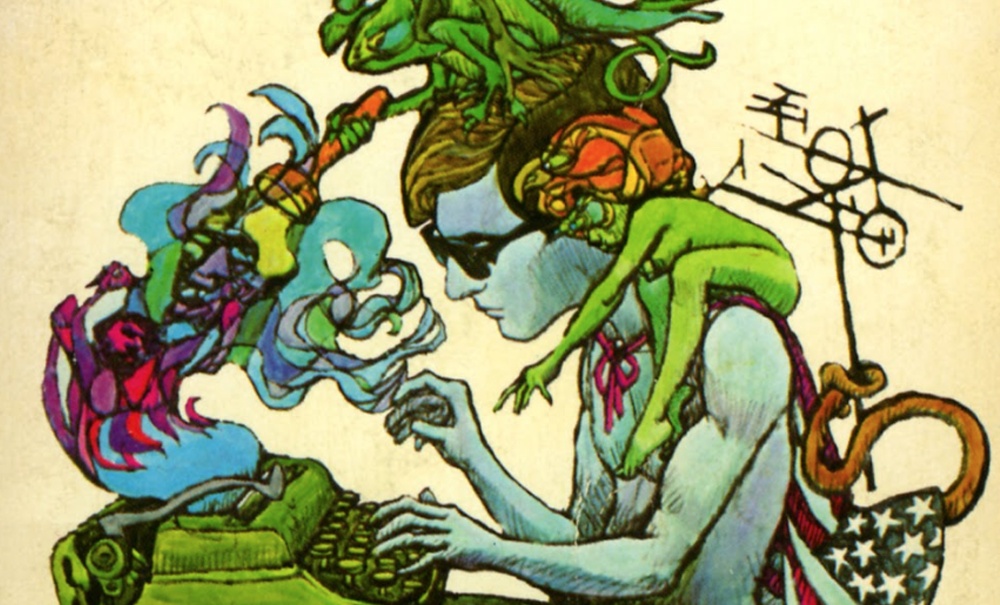
Now that Dick and Spiro and all their ghoul errand-boys are gone, you can read this book again.
I’m not much one for conspiracy theories—I’m not that paranoid yet but I’m getting there, I’m getting there—and so you’ll understand that I’m telling you nothing but the flat truth when I explain that Agnew and his minions scuttled this book the first time around, in 1970. I’ll even tell you how it happened, who to ask for verification that I’m not making it all up, and how it happens that The Glass Teat got a second chance…thereby proving I’ve been storing up some good karma.
As you’ll read in the introduction to the original edition of this collection of essays (it follows immediately hereafter), I started writing my television column for the Los Angeles Free Press in late 1968. I wrote the column every week for two and a half years; enough copy to fill two books of essays. The first was this one, originally published by Ace Books in 1970 as The Glass Teat, reprinted by Pyramid in 1975. The other book, with the balance of the columns, was to be published by Ace in 1971 as The Other Glass Teat. Second book never got born; and in that story lie the seeds of verification for everything I’ve set down in this book…everything about the rapacity and need to stifle criticism of Nixon’s reign, that is. I’m wrong about a few things—like the nobility of youth, f’rinstance—but then, even God made a few mistakes. Otherwise how do you explain poison ivy, tsunamis, and Donald Segretti?
As best I can make it (and getting cold-fact substantiation of the sequence of events was like trying to screw fog), here’s what happened:
Ace released the original version of this book in March of 1970. It was their leader. Nice promotion, nice package, a lightweight pr trip during which I covered the major markets in the West and on the East Coast. The column was still running in the Free Press and I was hyping the book through that medium, as well. Reviews started coming in. Excellent reviews. Several hundred of them, not a downer in the batch. Cronkite mentioned the book, Cecil Smith in the LA Times did an entire column on it, college newspapers picked up on it and said it was the best down-home look at tv ever published; lotta that kind of ego-buildup.
The publisher was overjoyed. Terry Carr, then an editor at Ace, the man who’d first decided to publish the book, felt vindicated; John Waxman (now a v-p at Ace but at the time the head of publicity and promotion) kept a box of the books under his office desk so he could fill special requests on the spot; several colleges ordered large quantities and adopted the book for their “media” classes.
Preliminary reports from the field, after two months, showed an incredible ninety percent sale on the first print run of 88,565 copies. Ace started talking about going back to press for another one hundred thousand copies, just in case we had hold of something that was taking off. Terry approached me for a second book, on instructions from the Ace higher-ups: “Sign him up for the sequel before the book hits so big he demands more money.”
On August 10th, 1970, I signed the contracts for The Other Glass Teat, for four thousand dollars advance, same as I’d gotten on The Glass Teat. And I kept on writing my columns, saying what I had to say about the condition of life in these here now United States, as viewed through the lens of television. Merely waiting till I hit column number 104 so the second book would be the same size as the first.
Then, suddenly, everything turned into a nightmare!
A friend called from Sacramento to tell me I’d been placed on Ronald Reagan’s “subversives list.” Dig it: this was four years before we were to learn of “enemies lists” via the Watergate route, though such lists undoubtedly existed at that time. My name was one of several hundred on a semi-public document being circulated out of the California state capitol, ostensibly setting out guidelines for colleges and universities who hired guest lecturers. There I was with Abbie Hoffman and Dave Dellinger and Jane Fonda and other CommieSymp radicals like John Ciardi and Dick Gregory. People our dear Unca Ronnie would frown upon being solicited to come and talk; the hook was, of course, that state funds might be withheld at budget time the following year, from institutions that chose to ignore this friendly suggestion. It wasn’t exactly a blacklist, just don’t breathe too deeply, y’know what I mean?
That was the first indication I had that maybe my big fat typewriter had gotten me in deep stuff with the shadowy Them who took as a concomitant of power the sneaky panther games we’ve come to know and love so well as brought to a fine Machiavellian art by King Richard the Phlebitten. What I didn’t know at that moment was that Spiro had been shown a copy of the book by someone on his staff, and had taken direct offense to a wayward line I’d written about him. What line? Uh, er…
“Spiro Agnew masturbates with copies of The Reader’s Digest.”
Uh, heh heh. All in, er, uh, good fun, Spiro…see, I was just trying to make a smartass reference to your oneness with the Common Man in America during that period, your homey-ness, your commonality of roots with Middle America, your utter sexlessness, your purity, your squeaky cleanliness. Not a mean thought in my bones, Spiro, honest to God.
Would you believe, gentle readers, Spiro took that line as a personal slur. Simply no pleasing some people!
I should have gotten the wind up when the rotten letters started coming in. From the Kiwanis in Florissant, Missouri. From the American Nazi party in El Monte, California. From the American Legion in Harrodsburg, Kansas. From a baling wire salesman in a motel in Talihina, Oklahoma. From my mother in Miami Beach, Florida.
And Ace’s running ads for the book in college newspapers, with the banner headline agnew’s answer! didn’t do much to help.
So there I sat with two grand of Ace’s money, just shucking and jiving, writing my columns, heading toward the 104th installment of The Glass Teat column, at which point I’d Xerox up the lot from installment #53 to installment #104, fire it off to Terry Carr in New York, and collect my remaining two grand advance money. But it didn’t work that way.
One day Terry called me. Now I’ve known Terry for close on twenty years, ever since we were both sf fans. He’s a tall, mostly quiet guy with an impeccable sense of decorum and restraint. Good editor, nice man, patience of Job. Can’t ever remember seeing him angry or demonstrably troubled, even when he was. Called me. Troubled. Heard it in his voice.
“Hi, Terry, what’s up?”
“Got some bad news for you.”
“Krakatoa isn’t ‘East of Java’?!”
“Serious.”
“Okay, sorry. What is it?”
“We’re not doing The Other Glass Teat.”
(Long silence.) (Fighting for breath.) (Battle won.)
“Don’t fuck around with me, man; it’s been a meatgrinder of a day.”
“I’m not kidding.”
“Well, shit, Terry! You’ve gotta be kidding because the damned book is selling ninety percent of its print run, so what the hell is the story?”
“I don’t know. I got the word from the front office. The returns are starting to come in. By the carloads. Some of the distributors aren’t even just tearing off the covers and sending them back; they’re sending back the whole damned book, boxes of them, most of them unopened, more every day, like they were plague carriers.”
I sat stunned. What the effulgent hell was happening!?!
Well, it was true. John Waxman called a week or so later and advised me the warehouse was filling up with returns of The Glass Teat. No explanations, no whys & wherefores, just thousands of copies bouncing back from all over America faster than the Night of the Lepus. By December 30th, 1970, what had looked like a sellout of the 88,565 copy print run turned out to be a total sale of 36,304. Don’t ask me what per cent that was; I was too stunned to know or care.
It didn’t make sense. I’d gotten a call from a friend who worked in the offices of Marboro, one of the biggest chain booksellers in New York. The Glass Teat had been their non-fiction leader for three solid weeks; they couldn’t get enough copies to stay in stock. And I knew for a fact that here in Los Angeles the damned book was moving faster than a Tijuana breakfast.
Terry called back a few days later and said Ace had told him to tell me I could keep the two thousand dollars I’d already received as first half of the advance. Just let them out of the contract for The Other Glass Teat. Book was mine, no claims, I could do what I wanted with it. Now, if you have ever had any dealings with Ace—world-renowned as the biggest thugs since Boss Tweed and a publisher known to hang onto a property unto the ninth generation—you will perceive my shock and stunned disbelief. They just wanted rid of me and that sequel.
So. What had happened, as best I’ve been able to piece it together since 1970, by asking discreet questions of people now four-years’ removed from the situation and somewhat less under pressure, was that the word had come down from what John Dean likes to call “the highest offices in the land” that The Glass Teat was a seditious, Communistic, mind-polluting snare of verbiage promulgated by elements bent on the violent overthrow of the Miss America Pageant, Let’s Make a Deal, Monday Night NFL Football, Matt Dillon, and, not incidentally, the United States of America as personified by the mouth that walked like a man, Spiro T. Agnew.
Distributors, newsdealers, wholesalers, and retailers, all got the clear but surreptitious message: this book ain’t for sale. Not nowhere, not nohow, not no way!
And Ace took a bath on the book.
And when they found out what was behind it, they jumped out of the contract for The Other Glass Teat with sighs of relief that they’d only lost two grand, and not their lives.
So for the next four years The Glass Teat—which had sold enormously well on either Coast, where all you radical swine congregate, polluting the precious bodily fluids of Amurrrica—began to acquire something of an underground reputation. I received hundreds of letters from college students and teachers who were using the book in their classes, handing around one dog-eared copy because they couldn’t find others, dog-eared or otherwise. Reviews continued appearing, all of them admiring. And here’s a little photo-extract from the Journal of Popular Culture just to prove I haven’t been dreaming all of this.