
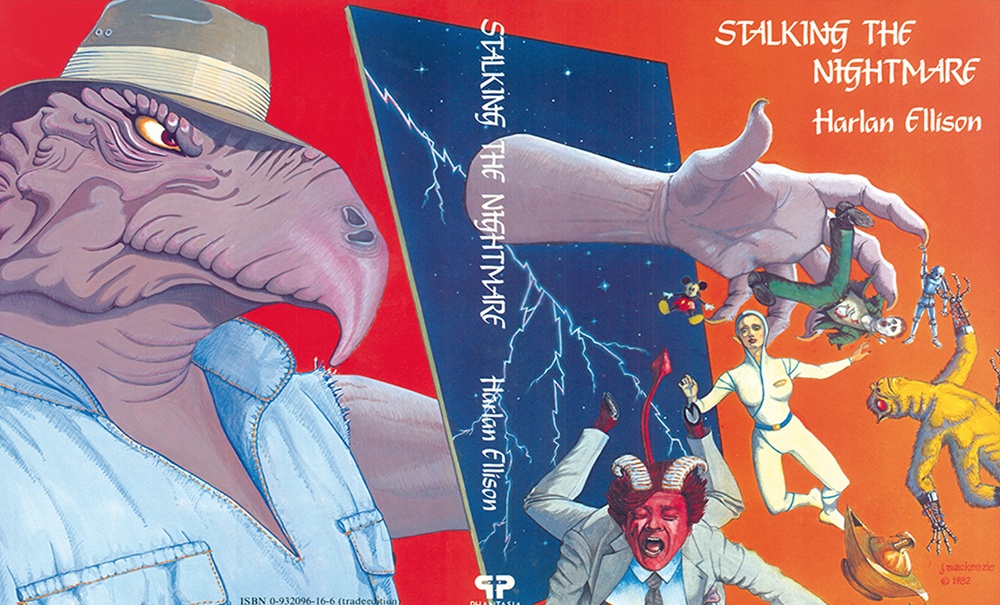
She thinks we were all killed when they made the Great Sweep, but I escaped in the mud.
I was there when the first dreams came off the assembly line. I was there when the corrupted visions that had congealed in the vats were pincered up and hosed off and carried down the line to be dropped onto the rolling belts. I was there when the first workmen dropped their faceplates and turned on their welding torches. I was there when they began welding the foul things into their armor, when they began soldering the antennæ, bolting on the wheels, pouring in the eye-socket jelly. I was there when they turned the juice on them and I was there when the things began to twitch.
No wonder She wanted all of us dead. Witnesses to their birth, to their construction, to their release into the air—not good. The myrmidons were loosed on the Great Sweep.
I think I am the last one left alive. The last one who can create dreams and not nightmares. I am the locust.
The reversal is sweet. What we always knew to be nightmares—the empty lives, the twisted language, the squeezing of the soul—they now call dreams. What we looked high to see as dreams—silliness, castles in the sky, breathing deeply on windy afternoons—She has commanded be termed nightmares, lies. I am the locust. I tell quiet lies. Called nightmares. That are truly fine dreams.
I swam in the mud till I was the color of the land. And made my escape. Overhead I saw the corrupted things soaring off to spread their rigor of obedience and fear and hatred. For many days I lay there, hidden, turning on my back for the rain, trapping small fish and insects for my food. Finally, when the Great Sweep was done and all my brothers and sisters were dead or locked away in madhouses, I went to the forest.
But like the locust that the Middle Ages saw as the symbol of passion, I will live forever. I will tell my quiet lies and no matter how blindly the people follow their instructions, in every generation there will be a hundred, perhaps a thousand, if chance is with them even a hundred thousand, who will keep the quiet lies alive. To be told late at night to the children. With their bright eyes they will pay attention, and the dreams that have been outlawed, now called nightmares, will take root and spread.
And fifty years from now, a hundred years from now, when She thinks all courage has been drained out of the people, the children of the locust will be retelling the quiet lies. We will never be eradicated. Decimated, yes, but still we survive.
Because in us lives the noblest part of the human experiment. The ability to dream.
I’ve watched, since the Great Sweep. Oh, what wonders She has given them in place of what they had. They have no real freedom, they have no genuine control of their lives, their days and nights are set down for them though they don’t even perceive it that way. But She has given them endless flickering images on screens: surrogate dreams (the real lies, the true nightmares) that make them laugh because they hear laughter behind the flickering images, and scenes of death and destruction that they think are representations of the real world that She commands be termed “news.” She has given them more and greater sporting events, young men and women hurling themselves at each other in meaningless contests She tells them represent survival in microcosm. She has given them fashions that obsess them—though they do not understand that the fashions are one more way of making them facsimiles of each other. She has given them acts of government that unify them into hive groups, in the name of removing responsibility from their daily lives. She has taken control completely, and now they believe that the grandest role they can play is that of cog in the machine of Her design. In truth, what they have become are prisoners of their own lives.
All that stands between them and the shambling walk of the zombie are the quiet lies the locust tells.
Because I keep on the move, I have come to miss two aspects of human congress more than all the others combined. Love and friendship. Before the Great Sweep I never had the time or the perseverance to discover what raids love can make on the boredom of silent days spent alone. Nights are worse, of course.
I long to share confidences with a friend. But because I have placed myself outside the limits of their society, I fear striking up acquaintances. Who would be my friend, in any event? I live in the last of the forests and I sleep in caves. The countryside is best for me. The cities are like the surface of the sun: great flares blast off the concrete; there are no places to hide, no cool corners in which to wait. Geomagnetic storms, sunspot occurrences, enormous air masses. I am wary of the cities. She rules without mercy there. And the people do not touch each other. Like those who are terribly sunscorched they avoid each other, passing in silence but with their teeth bared.
A day’s walk from the forest, there is a small town. I began going to the town innocently, making myself known by showing only that edge of myself that would not alarm anyone. And after a time I came to know a small group of young people who enjoyed hearing my stories.
Now they come to the small cave where I sit cross-legged. They do not tell their parents where they’re going. I think they gather roots and herbs as a cover for the afternoons in which they sit around me and I tell them of transcending destiny, of the three most important things in life, of true love, and of my travels. They lie about having gone on many picnics. And each time they bring one of their friends who can be trusted—one of the ones with that special sly, impish smile that tells me the flame burns steadily. Inside. Where She cannot snuff it out. Not yet. (I do not believe in Gods, but I ask God never to let Her discover a way of reading the inside of the people. If She ever finds a way to probe and drain the heart, or the head, then all hope will be lost.)
The young people surprised me. The last time they came, they brought a much older woman to the cave. She was in that stretch of life somewhere between seventy and the close of business. For an instant I cursed their enthusiasm. It had blurred their judgment. Now I would have to run again and find a far place to begin again.
But the sly smile was there on her wrinkled face as she stooped to enter the cave. Firelight caught my wary expression and as she entered, she drew a pinback button from the pocket of her padded jacket and clipped it on the left breast. It read: Étonne-moi!
She grinned at me as she sat down on the other side of the fire. “I read French imperfectly,” I said.
“Diaghilev to Jean Cocteau in 1909,” she answered. “Astonish me!”
I laughed, as the children settled down around us. How long had this woman kept her badge of defiance secret? Surely since the Great Sweep. My fears dissolved she was one of Her subjects. This dear old woman, corpulent and cat-eyed, with pain in her joints, was determined to live every moment until the end with sanctification. So I spun spiderwebs about looking for true love, about transcending destiny, about the three most important things in life, about times before the Great Sweep, and about just deserts.
“You’re a Calvinist,” she said. “Irreducible morality.” But she said it with humor, and I shrugged, feeling embarrassed. “I don’t think you really like shouldering the burden, even if you do it.”
“You’re right,” I answered. “I would gladly lay it down; if I knew others would carry it.”
She sighed. “We do, friend. We do.”
I learned later that She had sent myrmidons against the old woman and her brother; and they were killed. They had tried to lead a strike. No one joined them and they were caught out naked in the daylight. And were killed. The children told me. The terrible sight of it had not been wasted on them. They were angry when they told me.
I loved her, that old woman. She was the locust.
I heard the sound of the locust from the hills one night. It was a man with an alto saxophone playing all alone, long after midnight. He was playing the kind of music I haven’t heard in years. It was jazz. But it was the kind of sky-piercing jazz that long ago I had resisted, wondering if it was jazz at all. It had been rooted in the old order of what “Negroes” were lauded for playing, but as intense as steel, passionately soaring, the breaker of the circle. It had manifested radical inclinations; and I had refused to hear it.
But hearing it now, a solitary corner of one man’s loneliness, afloat in the night, I longed to hear more. To return in time to that place where the music had been new, and I swore if the miracle of transport could be done, I would listen without insisting memory be served. I would hear it without narrow judgments. The locust played “Green Dolphin Street” and “Since I Fell for You.” I remembered the name of the man who had played those tunes, years before the Great Sweep. His name had been Eric Dolphy, and I wished he would come down out of the far hills and travel with me.
I miss friendship. I miss music. What She gives them now, what She has led them to believe they want to hear, is as empty of human concern or enrichment as the fury of a thunderstorm.
It made me so sad, hearing him up there against the sooty night sky in which no stars had shone for a time beyond my recollection; a sky through which Her myrmidons flew to find old women and their brothers; a sky that would soon enough drop on the man with the horn. So sad I packed my few belongings in the rucksack…and I went away from the forest; from the cave, from the hills, and from the children. They would either hoard the quiet lies the locust had told, against the day when such tales would be needed, or they would follow their parents into the mouth of the machine She had oiled and set running.
Even I grow tired.
I warned them not to follow me. I am not the Pied Piper. They said, “We’ll go with you. We can trust you.” And I said, “Where I go there is no following. Where I go there is no mother, and no father; no safe days and no safe nights; where I go I go alone, because I travel fast.” But they followed. They hung back and I threw stones at them, then ran as fast as I could to lose them. But they kept coming. Three of them. Two boys and a girl. I wouldn’t let them sit with me when I rested, and they stayed out of range and yelled through the forest to me.
“Our parents stood by and watched. They didn’t lift a hand. When those things fell out of the sky and took the old woman and her brother, they didn’t do a thing. When they set fire to them, no one tried to stop them. We can’t live with people like that. You told us what that means.”
I tried not to listen. I am not their leader. I am just the locust. I cannot even lead myself. I cannot do what they think must be done. All I can do is tell them quiet lies.
That isn’t enough.
Some among them have to take the strength upon themselves. Some among them must rise up from their midst to lift the real burden. Must I do all the work?
I can tell them of the night of black glass, and of the hour that stretches, and of the visionary…but I am no one’s hero.
I waited behind a tree and when they passed I stepped out and explained my limitations, the amount of burden I was prepared to carry. They smiled the impish smiles and said I was better than that; I could beat off myrmidons with my bare hands; I was their inspiration. I slapped one of the boys. He took it and looked hurt, but they wouldn’t leave me.
A man hides in the far hills and plays slow soft melodies. Nothing more is asked of him. Until he goes to the final sleep. That is a peace greatly to be desired. Why can’t they hear the message? Do any of them really listen?
I struck out again, and let them fend for themselves.
And when She sensed our movement, because there were four of us, unauthorized, moving at random, She sent the nightmares on their night flight, like bats that see in the dark, and they fell upon us. And I did not stay to help them. In the chaos I escaped, went into the ground and hid. I tried not to think about the sounds the children made. And finally there was silence.
There are no leaders. There are only terrified souls trying to live till the day when She loses control and the machine turns on Her. Until that day, unless I find a distant hill where the final sleep will free me, I will tell my quiet lies. There is nothing more to it than that.
There are no heroes of my generation. That role has yet to be filled. For my part, I am just the locust.
I speak of dreams called nightmares. No more should be expected, at risk of driving the reflection so deep into the mirror it will never emerge again.
The ability to dream is all I have to give. That is my responsibility; that is my burden. And even I grow tired.
Harlan Ellison
Los Angeles
18 February 1982