
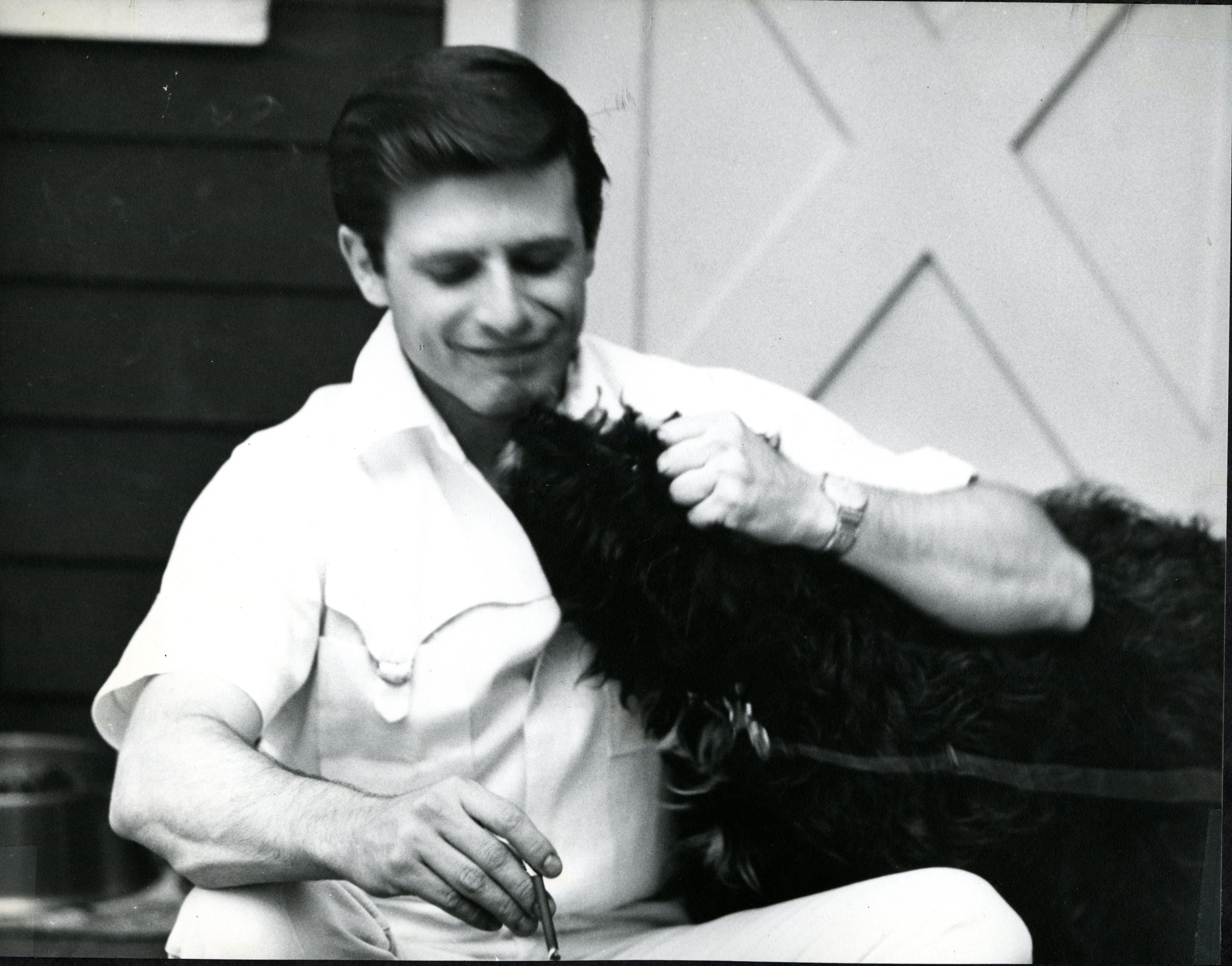
Last year, my dog died.
There’s nothing more maudlin than reading someone’s treacly and bathetic self-pity in the form of a lament for a pet. Nonetheless, the death of my dog, Ahbhu, did me in. And rather than drowning myself in the loneliness of it, I did what I usually do when I’m going through changes of sadness that I can’t handle. I put it into a story. The story was called “The Deathbird,” and it appeared in The Magazine of Fantasy and Science Fiction for March.
It will be the title story of my Harper & Row collection, DEATH-BIRD STORIES, in February or March of next year.
But that section about Ahbhu has brought some odd and sympathetic reactions from large audiences, and so I thought I’d share it with you, here, seeing as how I’ve bared my soul in so many other ways.
I thought it might be nice if you saw—after last week’s ugly tirade against humanity—that I am capable of love.
Yesterday my dog died. For eleven years Ahbhu was my closest friend. He was responsible for my writing a story about a boy and his dog that many people have read. He was not a pet, he was a person. It was impossible to anthropomorphize him, he wouldn’t stand for it. But he was so much his own kind of creature, he had such a strongly formed personality, he was so determined to share his life with only those he chose, that it was also impossible to think of him as simply a dog. Apart from those canine characteristics into which he was locked by his species, he comported himself like one of a kind.
We met when I came to him at the West Los Angeles Animal Shelter. I’d wanted a dog because I was lonely and I’d remembered when I was a little boy how my dog had been a friend when I had no other friends. One summer I went away to camp and when I returned I found a rotten old neighbor lady from up the street had had my dog picked up and gassed while my father was at work. I crept into the woman’s backyard that night and found a rug hanging on the clothesline. The rug beater was hanging from a post. I stole it and buried it.
At the Animal Shelter there was a man in line ahead of me. He had brought in a puppy only a week or so old. A Puli, a Hungarian sheep dog; it was a sad-looking little thing. He had too many in the litter and had brought in this one either to be taken by someone else, or to be put to sleep. They took the dog inside and the man behind the counter called my turn. I told him I wanted a dog and he took me back inside to walk down the line of cages.
In one of the cages the little Puli that had just been brought in was being assaulted by three larger dogs who had been earlier tenants. He was a little thing, and he was on the bottom, getting the stuffing knocked out of him. But he was struggling mightily.
“Get him out of there!” I yelled. “I’ll take him, I’ll take him, get him out of there!”
He cost two dollars. It was the best two bucks I ever spent.
Driving home with him, he was lying on the other side of the front seat, staring at me. I had had a vague idea what I’d name a pet, but as I stared at him, and he stared back at me, I suddenly was put in mind of the scene in Alexander Korda’s 1939 film The Thief of Bagdad, where the evil vizier, played by Conrad Veidt, had changed Ahbhu the little thief, played by Sabu, into a dog. The film had superimposed the human over the canine face for a moment so there was an extraordinary look of intelligence in the face of the dog. The little Puli was looking at me with that same expression. “Ahbhu,” I said.
He didn’t react to the name, but then he couldn’t have cared less. But that was his name, from that time on.
No one who ever came into my house was unaffected by him. When he sensed someone with good vibrations, he was right there, lying at their feet. He loved to be scratched, and despite years of admonitions he refused to stop begging for scraps at table, because he found most of the people who had come to dinner at my house were patsies unable to escape his woebegone Jackie-Coogan-as-the-Kid look.
But he was a certain barometer of bums, as well. On any number of occasions when I found someone I liked, and Ahbhu would have nothing to do with him or her, it always turned out the person was a wrongo. I took to noting his attitude toward newcomers, and I must admit it influenced my own reactions. I was always wary of someone Ahbhu shunned.
Women with whom I had had unsatisfactory affairs would nonetheless return to the house from time to time—to visit the dog. He had an intimate circle of friends, many of whom had nothing to do with me, and numbering among their company some of the most beautiful actresses in Hollywood. One exquisite lady used to send her driver to pick him up for Sunday afternoon romps at the beach.
I never asked him what happened on those occasions. He didn’t talk.