
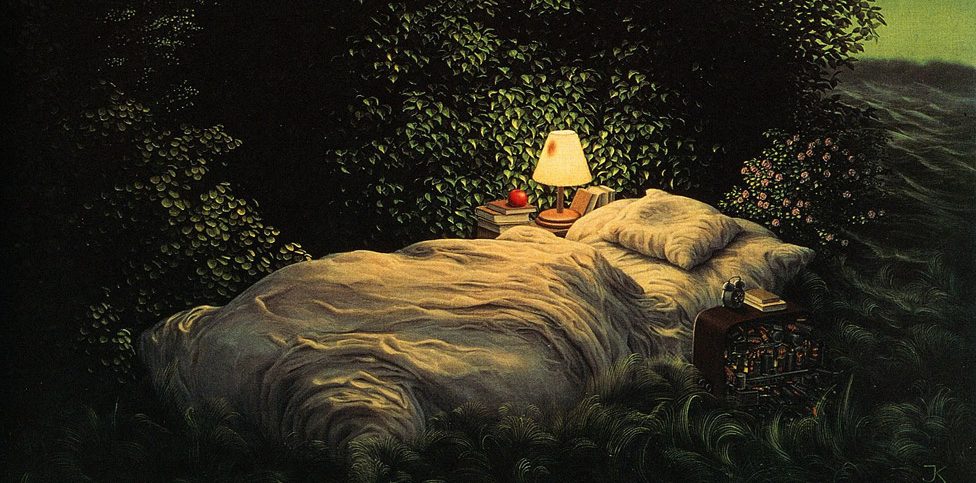
As she had done every night since they met, she went in bare feet and a cantaloupe-meat-colored nightshift to the shore of the sea of mist, the verge of the ocean of smothering vapor, the edge of the bewildering haze he called the Brim of Obscurity.
Though they spend all their daytime together, at night he chose to sleep alone in a lumpy, Volkswagen-shaped bed at the southernmost boundary of the absolutely lovely forest in which their home had been constructed. There are the border between the verdant woods and the Brim of Obscurity that stretched on forever, a sea of fog that roiled and swirled itself into small, murmuring vortexes from which depths one could occasionally hear something like a human voice pleading for absolution (or at least a backscratcher to relieve this awful itch!), he had made his bed and there, with the night-light from his old nursery, and his old vacuum-tube radio that played nothing but big-band dance music from the 1920s, and a few favorite books, and a little fresh fruit he had picked on his way from the house to his resting-place, he slept peacefully every night. Except for the nightmares, of course.
And as she had done every night for the eight years since they had met, she went barefooted and charmed, down to the edge of the sea of fog to kiss him goodnight. That was their rite.
Before he had even proposed marriage, he explained to her the nature of the problem. Well, the curse, really. Not so much a problem; because a problem was easy to reconcile; just trim a little nub off here; just smooth that plane over there; just let this big dangle here and it will all meet in the center; no, it wasn’t barely remotely something that could be called “problem.” It was a curse, and he was open about it from the first.
“My nightmares come to life,” he had said.
Which remark thereupon initiated quite a long and detailed conversation between them. It went through all the usual stages of good-natured chiding, disbelief, ridicule, short-lived anger at the possibility he was making fun of her, toying with her, on into another kind of disbelief, argument with recourse to logic and Occam’s Razor, grudging acceptance, a brief lapse into incredulity, a return to the barest belief, and finally, with trust, acceptance that he was telling her nothing less than the truth. Remarkably (to say the least) his nightmares assumed corporeal shape and stalked the night as he slept, dreaming them up. It wouldn’t have been so bad except:
“My nightmares killed and ate my first four wives,” he had said. He’d saved that part for last.
But she married him, nonetheless. And they were extremely happy. It was a terrific liaison for both of them. But just to be on the safe side, because he loved her very much, he took to sleeping in the lumpy Volkswagen bed at the edge of the forest.